Mounting a time-lapse camera on a construction crane is one way to capture a bird’s-eye view of a construction site. It gives you an overview of the site and allows you to closely monitor the various activities. However, mounting the camera on a crane isn’t the best choice for every type of video recording.
Whether a camera is best mounted on a tower crane, on a building, or on a separate camera mast depends on the purpose of the footage. Do you mainly want to monitor the technical progress of the work, or do you want to create a visually appealing time-lapse that shows the building’s growth? We answer the most frequently asked questions about mounting a time-lapse camera on a tower crane.
Yes. A tower crane can be a good location for a time-lapse camera. Thanks to its height and wide field of view, you can capture a large portion of the construction site.
A camera mounted on a tower crane is particularly useful when you want to monitor the various activities on the construction site. These include earthwork, foundation work, material handling, crane operations, and the overall organization of the site.
The elevated vantage point makes it possible to view the activities from a different perspective than from the ground.
The main advantage is the overview it provides. From an elevated vantage point, you can observe different areas of the construction site at the same time. This is useful for project managers, site supervisors, and others involved who want to monitor the progress of the work from a distance.
Other benefits include:
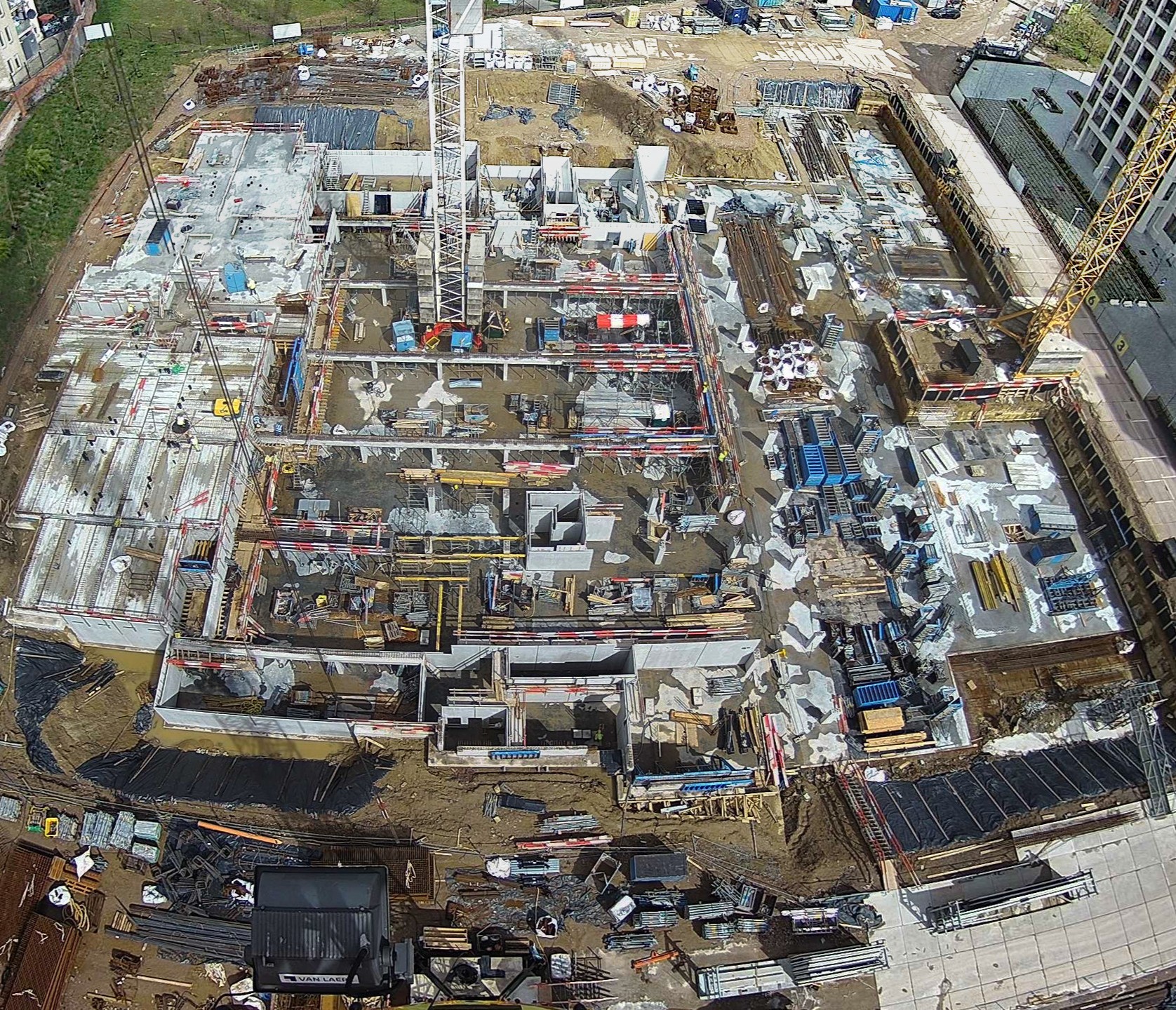
A high vantage point offers a broad view, but it is not necessarily the best perspective for showing the evolution of a building.
1. It's harder to see how the building is taking shape
From above, you’re mainly looking down on the project. As a result, it’s harder to see how the building is gradually rising, how the facades are taking shape, and how the different floors are developing.
For technical project monitoring, that doesn't have to be a problem. If you want to use the footage for communications, presentations, or a final time-lapse, a side view is often more interesting.
2. The camera angle changes based on the crane's movements
A tower crane rotates during construction work. As a result, a camera mounted on the crane’s moving parts frequently changes its angle of view. This does not have to be an issue for the technical monitoring of a construction site. You can still view the activities and track progress.
It’s less ideal for marketing and communication purposes. A consistent visual composition is important if you want to create a single, seamless time-lapse video from start to finish. Changing camera angles make that impossible.
3. The camera position is linked to the crane's schedule
A tower crane is usually dismantled after the roof is completed. If you still want footage of the project’s subsequent completion, you’ll need to arrange an alternative location in a timely manner to continue filming. This change in position also means you won’t end up with a continuous time-lapse video.
4. Installing and removing the camera isn't always easy
A camera mounted on a tower crane is not easily accessible. When performing maintenance, the necessary safety precautions must be taken, and the crane must be temporarily taken out of service.
No. A camera doesn't have to be mounted higher than the finished building to get a good view.
The camera's height is just one factor in determining the correct perspective. The distance from the building, the viewing direction, and the position relative to the various facades also play an important role.
A camera positioned at a lower angle—for example, aimed at a corner of the building—can actually produce even better results. The perspective allows you to see more depth, multiple facades, and the successive stories of the building. This makes the building’s evolution much more clearly visible.
The goal is not to see as much as possible from above, but to capture the project from the most useful angle.
That depends on the intended use of the images.
When selecting a camera position, we take into account the size and layout of the construction site, the surrounding area, the expected building height, and the desired end result.
Not necessarily. Both solutions have their own applications.
A tower crane often provides a wide field of view, which is useful for monitoring construction work. A separate camera mast or mounting on a building makes it easier to maintain a fixed angle of view throughout the entire construction process.
For a time-lapse video that focuses on the growth of a building, a fixed shooting position is usually preferred. This makes it easy to compare footage from different points in time and ensures a consistent time-lapse video.
Furthermore, a fixed position doesn't have to be particularly high. A well-chosen vantage point at a lower elevation can yield a much more powerful image.
Choosing the right camera position starts with asking yourself what you want to use the footage for. We distinguish between three main purposes:
In practice, these applications often overlap. A single well-chosen camera position can provide valuable insights for project monitoring as well as images for communication and sales.
At C-SITE, we therefore tailor the camera position to the specific characteristics of the project and the various ways in which the images will be used. This allows clients to make extensive use of their photos and videos.
Curious to know what approach we recommend for your project? Feel free to contact us with no obligation.

